The
passenger's view from the train:
Llandudno
Junction to Blaenau Ffestiniog.

An Arriva Trains Wales 150/2 at Llandudno on a Conwy Valley service.
Our train, which has probably come from Llandudno, leaves the main line just east of the station. On the right can be seen the now disused rail freight terminal, oil depot and coal yard. Our train passes under the A55 and the area of marshland on our right is a bird sanctuary owned by the RSPB and open to the public. The sanctuary is built on land which was reclaimed following the construction of the Conwy road tunnel. Having passed this point, we are presented with a very fine view of the Conwy Estuary at its widest point.

48151 leaving Llandudno Junction on August 25th 2010 hauling the last of three steam hauled excursions from Preston to Blaenau Ffestiniog run that year. This loco was used on all three. Two further excursions using this loco were run in 2011.
Conwy Castle, with its attendant bridges and town walls, is clearly seen as is the embankment carrying the former main road and railway. We soon arrive at our first stop - Glan Conwy. Like all the stations on the branch this is unstaffed, tickets being taken and issued by the conductor-guard. Another point of interest is the set of wooden steps to assist passengers in and out of the train. This station, and also the one at Dolgarrog, have been reopened in recent years having originally been closed under the Beeching Plan. At low tide, the marshes here, and indeed the whole length of the tidal River Conwy, is a paradise for bird-watchers - herons, mallard, shelduck, curlews, little egrets and oyster-catchers, to name but a few, are clearly visible.
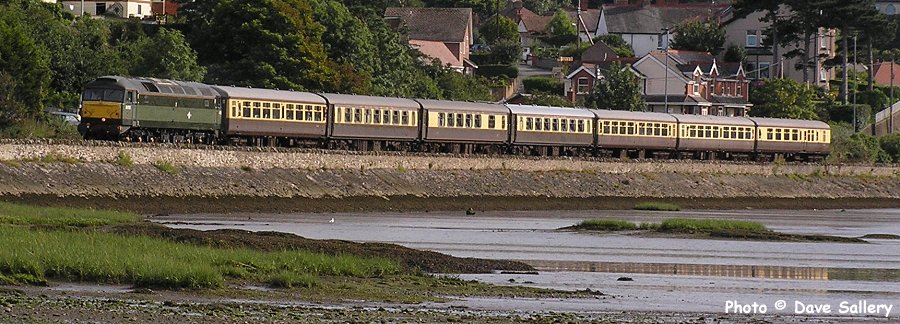
47773 on a returning Tyseley - Blaenau excursion, Glan Conwy, 18-08-2012
Leaving Glan Conwy behind, the estuary now begins to narrow. We continue south, following the river's every turn, with the hills and mountains becoming noticeably closer. The mountains to our right are known as the Carneddau and form the largest area over 3000 feet south of the Scottish Highlands. Hidden among the trees to our left are the celebrated Bodnant Gardens, owned by the National Trust, and well worth a visit. A particularly good time to visit is in the late spring when the famed Laburnum Arch is in full bloom.

20187 and 075 are working the second Trawsfynydd Trekker railtour on 10th September 1994, at the other end of the six coach train were 31238 and 31207. The train is seen by the River Conwy approaching Tal y Cafn.
Our next stopping point is Tal y Cafn. The station here has been adopted by the Llandudno and Conwy Valley railway society. The road bridge over the Conwy at Tal y Cafn replaced a ferry crossing, which had existed since Roman times. Shortly after leaving Tal-y-Cafn, the old church of Caerhun is seen on the opposite bank, surrounded by ancient yew trees. Nearby are the remains of the Roman settlement of Canovium. If you follow the lines of pylons to the skyline on the right you will see the historic pass of Bwlch Ddeufaen. This was the route of the Roman road from Canovium to Segontium (Caernarfon). It was also a stage-coach route from Anglesey and Ireland before the coastal route via Penmaenmawr was built.

37377 and 098 with the snow covered Carneddau mountains in the background, April 18th 1998.
Continuing in close proximity
to the river, the nearest conical peak, on our right, is Pen
y Gaer, site of a well-preserved Iron Age hill-fort.
Our next calling-point is Dolgarrog,
the village itself is on the other side of the river.
Dolgarrog leapt to prominence in 1925, when a dam supplying
water to the hydroelectric power plant at the aluminium
works, gave way. The ensuing flood caused sixteen
deaths. and many injuries. The gash in the old
unrepaired dam walls is still visible high up in the hills
as a sombre reminder. The bridge over the river here
originally carried a siding to the, now disused, aluminium
works, visible on the right. The bridge is now,
however, only safe for pedestrians.
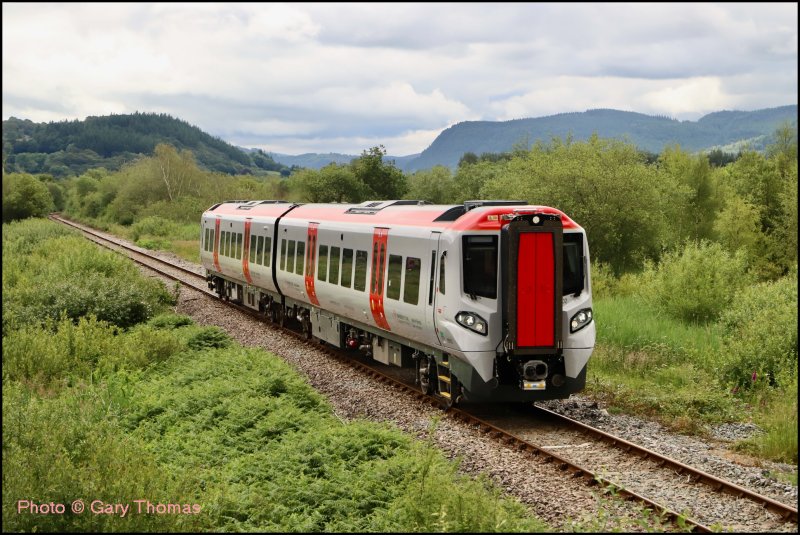
Brand new 197002 is seen on a test run to Blaenau in the valley just South of Dolgarrog, 24th June 2021. Photo by Gary Thomas.
We continue up the slowly narrowing valley along a section very liable to flooding in winter. The boulders along the side of the line being placed there in order to prevent the ballast being swept away, as has happened quite frequently in the past.
We are now at the limit of the tidal Conwy, and the long straggling village across the river is Trefriw, this was formerly served by pleasure steamers from Conwy. This village is well known for its woollen-mill, and its chalybeate mineral-water springs, reputedly of medicinal value.
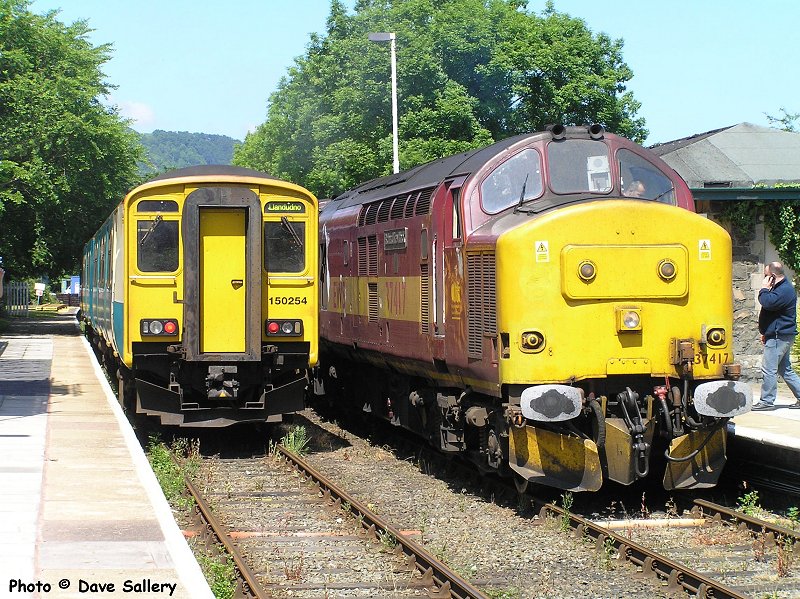
37417 and 150254 pass at North Llanrwst station.
Arrival at North Llanrwst, now a request stop, is marked by the start of the crossing loop which comes just before the rather imposing but derelict station building. This is the only passing loop and signalbox on the line. The interested observer may watch the exchange of metal tokens between our driver and the signalman. This process ensures complete safety in the working of trains on a single-track railway.
After a short run we arrive at the new Llanrwst station opened on the 29th of July 1989 as an act of faith in the future of the line. This station is far closer to the centre of the town. Llanrwst is a pleasant little Welsh market town and has a splendid road bridge over the Conwy, built by Inigo Jones in 1636, it is still in use today. Nearby is Gwydir Castle, once famed for its peacocks. Leaving Llanrwst, the heavily forested hill to our right was once a major centre for lead-mining. However, since those days, much reclamation has taken place, and there are some delightful signposted walks and mountain bike trails to be enjoyed. We now cross the River Conwy on a steel girder bridge, and enter the Snowdonia National Park.

37886 is on the rear of an excursion crossing the River Conwy in October 2002.
Soon we arrive in Betws y Coed. Although only a small village, it stands at the meeting-point of three rivers: the Lledr, which we will follow for the next part of our journey; the Llugwy, which flows down from Capel Curig and drains a large part of the Glyder and Carneddau ranges and, of course, the Conwy. Betws y Coed itself has much to interest the casual visitor, and it is a major centre for the tourist industry. At the station itself, a particular attraction is the Conwy Valley Railway Museum, and miniature trains may frequently be seen running alongside their larger counterparts. At the Stablau Visitor Centre, near the station can be found details of guided walks starting from stations along the line and other attractions. Betws is also a starting-point for the Snowdon Sherpa bus service for spectacular trips around Snowdonia.
The next part of this journey is what really makes this railway line something special. So far, the journey has been along a pleasant pastoral river valley. However, we are about to enter the very heart of the Welsh Mountains. Although the line to Llanrwst was opened in 1863, and to Betws y Coed in 1868, a further eleven years elapsed before the first train steamed triumphantly into Blaenau Ffestiniog, on 22 July 1879. Indeed, at one time the London & North Western Railway seriously considered building the line to the narrow gauge of 1 foot 11 1/2 inches, the same as the Ffestiniog Railway, because of the difficult terrain. Victorian fortitude prevailed, however, and one can readily appreciate from the train how steep and sinuous is the course eventually chosen.

67029 on a route learning working passing Betws y Coed in 2004. The Conwy Valley railway museum is on the right.
Leaving the station, look out for the bridge on our left. This carries the main A5 London-Holyhead road, and the arch of the bridge has the inscription that it was built in the same year in which the Battle of Waterloo was fought - that is - 1815. Following a short spell in dense conifer forest, Beaver Pool Tunnel is followed by the stretch of water of that name. This can be glimpsed through the trees down to our left. This marks the confluence of the rivers Conwy and Lledr, our course following the latter. The upper stretch of the Conwy from this point is known as the 'Fairy Glen', and is a spectacular stretch of rocky pools and surging cataracts. A recent addition in the Fairy Glen is a fish ladder to enable Salmon to colonise the upper reaches of the Conwy.
The harsher engine noise of our train gives a hint of the severe gradients which are now encountered as we continue up the narrow, thickly wooded valley. A temporary respite for steam trains was provided by Gethins Bridge. This is a handsome, stone-built viaduct of seven arches, carrying the railway across the river and the main road. The track across the viaduct itself is level. Waterfalls and rock pools abound in the river, now well below on the right and we soon enter the short, unlined rock tunnel emerging at Pont y Pant station. A spectacular waterfall on the River Lledr is near by and well worth a visit.

The rocky portal of Pont y Pant tunnel.
Another short tunnel brings railway and river together again. A more gentle stretch of track follows past the water-meadows to Dolwyddelan. The impressive peak on the right is Moel Siabod, 2861 feet/872 metres. Disused slate quarries can be seen on both sides, this being at the northern limit of the Blaenau slate measures. Dolwyddelan is a picturesque peaceful village, and excellent rock-climbing and walking are available in the vicinity.

101 685, affectionately known as Daisy, near Roman Bridge in 1994.
Leaving this station, to the right is the stark, square tower which is all that remains of Dolwyddelan Castle. This was the birthplace of the native Welsh Prince Llewelyn ab Iorwerth (Llewelyn the Great) in the twelfth century. Prince Llewellyn is commemorated in the name of Carnedd Llewellyn, one of the highest Welsh peaks. The castle is steeped in Welsh mythology, and is open for visiting courtesy of Cadw. Continuing up the valley, through the short Bertheos Tunnel and under the new road bridge, Snowdon and its attendant peaks may be seen above the open moorland directly ahead. We have now parted company with the main road, which climbs steeply up to the Crimea Pass, named after a public house which formerly stood at its summit. This road can sometimes be blocked by snow in winter.

An excursion train at Roman Bridge with 47798 "Prince Henry".
The charmingly named, and situated, Roman Bridge is followed by a further short tunnel. There is however no evidence that the Romans ever built a bridge here. We continue up the narrowing rocky valley, the wheel flanges of our train squealing on the incessant curvature as the train tries to seek out the most level path for our progress. A lonely final stretch, with nothing but sheep for company, leads us to the north portal of the celebrated Ffestiniog Tunnel.
This tunnel, at 3,726 yards, is the longest single-track and the eighth longest tunnel overall, in Britain. Apart from a short curve at the north end, the tunnel is perfectly straight. Construction of this tunnel took four years of hard toil, amid flooding, rock-falls, and explosions. The extremely hard rock required special drills and consequently the tunnel needs no lining. The summit-level of the line at 790 feet, is in the middle of the tunnel, and after what always seems an age in the darkness, we suddenly burst into the open to be confronted by an astonishing view.

National Power owned 59205 nears Blaenau Ffestiniog on April 18th 1998. The Oakeley Quarry slate tips are behind the train.
Few towns in Britain can have so spectacular or intimidating an entrance as Blaenau Ffestiniog, with vast tips of slate waste towering precariously around the train, and all in the shadow of lofty mountain peaks. The slate waste to the right forms part of what were formerly the Oakeley slate quarries. This was until recently a tourist attraction known as Gloddfa Ganol but nowadays the complex is owned by Welsh Slate and is not open to the public. The quarry was mothballed in April 2010 due to a downturn in the industry. This was once the largest slate-mine in the world and had twenty-six floors. The vertical difference in the quarry was 1,400 feet and it was served by 50 miles of 2 foot gauge railways. Because slate extraction often produces up to 90% of waste material to 10% usable product, the size of the waste tips gives an indication of the frantic activity which occurred during the boom years. The tips on the left form part of the Llechwedd complex, now home to the world-famous Miners' Tramway. The train now passes under the remains of Glan y Don viaduct. This once supported a spindly wooden trestle carrying 2 foot gauge slate vehicles. A short distance further on, on the right, there used to stand a row of terraced houses, the rapacious desire of the Oakeley quarry owners for more tipping space however led to their evacuation and subsequent burying.

37401 and 37417 wait in the loop at Blaenau Ffestiniog with the slate tips towering above, 31st May 2008.
With the Afon Barlwyd, which flows into Cardigan Bay, on the right, the train soon passes the rolling stock storage sheds of the Ffestiniog Railway at Glan y Don. Next comes the long disused Blaenau Ffestiniog North station, closed in 1982 but still largely intact. Shortly afterwards, as the valley widens, the Ffestiniog Railway itself trails in from Porthmadog and parallels us for the short distance to Blaenau Ffestiniog Central Station. This station was newly opened in 1982, following the reopening throughout of the Ffestiniog Railway. This station is built on the site of the Great Western station of the same name which closed in 1961. We have now reached the end of the line although the track continues for a further 5 miles to Trawsfynydd nuclear power station. This section is now disused following the decommissioning of the power station. Formerly there was a regular traffic in nuclear waste to Sellafield from Traws, as it is known locally. Originally this line continued as far as Bala, where connection was made with the now also closed Ruabon to Barmouth line.

Little and large meet up in Blaenau Ffestiniog.
The delights of Blaenau Ffestiniog and its surroundings are many in number. The slate-mines, walking, rock-climbing, and views are unsurpassed. The little changed streets of the town itself give ample cause to remember a time when it was the slate capital of the world.

Earl of Merioneth is ready to leave Blaenau on a Ffestiniog Railway train to Porthmadog.
Next page: a map of the line