'The Borderlands line'
The view from the train - Wrexham to Bidston

A service to Bidston at Wrexham Central.
 A view from the cab from Wrexham to Bidston can now be viewed on Youtube
The new WREXHAM CENTRAL station opened for business on October 23rd 1998 and is located at the edge of the busy Island Green Retail Park. There is also easy access from the station into Wrexham town centre. As Wrexham Central is an unstaffed station, tickets must be purchased from the conductor on the train. Leaving Central station on the single line, the redeveloped site of the Wrexham Lager Brewery is passed on the right hand side. Wrexham had a long tradition of brewing and this was the final brewery to remain in operation. The closure of Border Breweries in the town some years ago is still remembered with sadness. The train now passes under the bridge carrying the former Great Western Railway line from Shrewsbury to Chester.
The line now curves sharply to the right to arrive at WREXHAM GENERAL . When it was a separate station it was known as Wrexham Exchange. The single platform is operated as part of the adjacent General station which has recently been attractively refurbished. The booking office at General station is able to supply the full range of rail travel facilities. Services today are run by Arriva Trains Wales. Trains run from General station to destinations including Shrewsbury, Birmingham, Cardiff, Chester and Holyhead.
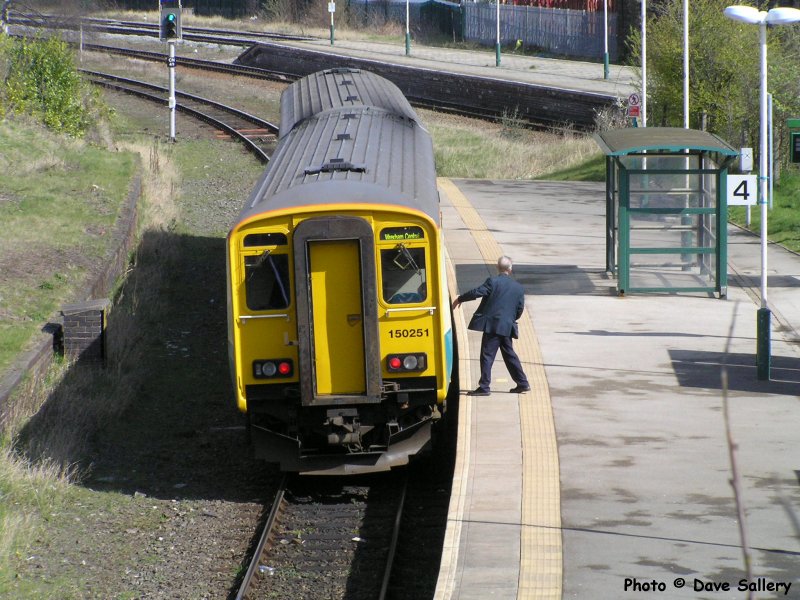
150251 at Platform 4 of Wrexham General station on a Bidston service.
Until 1966 there was a regular through service from Birkenhead Woodside to London Paddington on this route. Wrexham & Shropshire Railway introduced a new five times a day service from Wrexham General to London Marylebone from 28th April 2008, sadly this service ended on January 28th 2011. Leaving General station there is a single track connection to the Shrewsbury - Chester line on the right. This is the only link the Wrexham - Bidston line has with the rest of the rail network apart from using the Mersey rail tunnel.
The Borderlands line now becomes double track and on the left hand side Rhosddu locomotive depot used to stand. The line parallels the ex GWR route to Chester for about a mile and then curves to the left under the Wrexham By Pass. After about another mile it is just possible to make out, on the left, where the triangular junction of the WM&CQR line to Brymbo once was.

Gwersyllt looking towards Wrexham. The dip in the track is where the North Wales Mineral Railway formerly crossed over.
Another relic of the past can be seen shortly before we arrive at GWERSYLLT. This is the bridge which formerly carried the North Wales Mineral Railway to Brymbo via the Wheatsheaf incline over the line. Gwersyllt is typical of most stations on the line being unstaffed but recently refurbished.

A Pacer unit on the Cegidog Viaduct near Cefn y Bedd in 1993. The train is in Greater Manchester livery
After leaving Gwersyllt the train passes under the Mold - Wrexham main road and head towards the first summit on the line near what was once the site of Ffrwrd Junction, now hidden in trees on the left. From here a branch line rose steeply to what was once an extensive complex of collieries, brickworks and an iron works. There are very few traces left of this today. The line now heads down through Sydallt and crosses over the viaduct carrying the line over the River Cegidog. The viaduct is of five stone arches and is one of the route's most impressive architectural features. CEFN-Y-BEDD follows almost immediately. This station still retains most of its original buildings although those on the Bidston platform are in private ownership. This station also serves the village of Abermorddu.

150251 at Cefn y Bedd on a Wrexham service, access between the platforms is via a foot crossing
Between Cefn-y-bedd and Caergwrle, our next station stop, there was formerly a branch line on the right serving the large Llay Main colliery and Llay Hall brickworks. Little trace remains of this once important junction nowadays. CAERGWRLE was once known as Caergwrle Castle and Wells and was a popular day trip destination particularly from Merseyside. The ruined Caergwrle Castle is on top of the hill on the left. The castle was built in 1277. The original waiting shelter still exists on the Wrexham platform and is of a design unique to this line.

The Wrexham side shelter at Caergwrle is seen in 'LNER livery' in April 2008
Immediately after leaving Caergwrle station there was once a private siding to a brewery on the left. The train now crosses over the River Alyn on a girder bridge and after a short run arrives at HOPE. The main point of interest in Hope is its attractive church. A long straight stretch follows and on the left may soon be seen the extensive lagoons created by gravel quarrying. Towards the end of this straight stretch of track the line steepens and begins the climb to the summit of the line at Buckley.
PENYFFORDD is the next station stop. The station here is given added importance because it also possesses a signal box, the only one between Wrexham and Dee Marsh. The signal box is at the end of the Bidston platform. Just beyond the signal box on the left can be seen the now weed infested connection to the Chester - Mold - Denbigh line. The passenger service from Chester was withdrawn in 1962 but this connection was retained to provide access to Mold. The freight service to the Synthite Company, the last user of the line, finished in 1981 and the track has now been removed. The sidings now terminate after a couple of hundred yards.

Winter at Penyffordd. 142049 on a Wrexham service in 1998
After Penyffordd the gradient steepens as the line heads towards the summit at Buckley. A short level section of track and ruined platforms indicate the site of Hope Exchange station where passengers formerly changed for the Chester - Mold - Denbigh line. Shortly after, the extensive works of Castle Cement are seen on the left. The sidings here receive trainloads of imported coal although cement is no longer sent out by rail. Just before BUCKLEY, formerly known as Buckley Junction, is reached the original line to Connahs Quay climbed away on the left. This line served the Buckley brick and tile industry and numerous collieries. In the earliest days there was a considerable traffic in bricks to Connahs Quay for export by ship. Much of this was carried in specially adapted tramway wagons known as shipping boxes. These were run onto the standard gauge wagons at the brickworks and then loaded by crane at Connahs Quay directly onto the ships. This process avoided transhipment and consequent damage to the fragile cargo. As the brick industry declined so did the railway and final closure came in the early sixties. A coal merchants yard survived at Buckley Junction for some years after. Parts of the original Buckley railway line can be followed by footpath but much of the trackbed has vanished beyond trace. Buckley station still retains its original buildings on the Bidston side although these are now in industrial use.
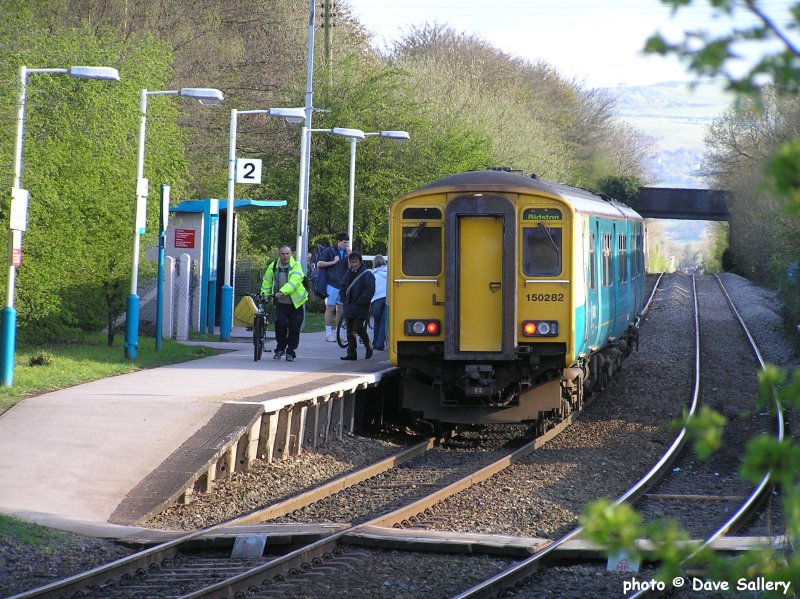
A Wrexham service calls at Buckley
A pleasant stretch of track through fields and woodlands follows as the line descends steeply to HAWARDEN . Hawarden was once a popular day trip destination for Merseyside and a large waiting shelter formerly existed on the Bidston side. The attraction of Hawarden in those days was its association with the Gladstone family who lived nearby in Hawarden Castle. No trace remains today of the signal box and water tower which formerly stood at the Wrexham end of the station.

An ex Strathclyde unit, 101694, calls at Hawarden August 2000
Leaving Hawarden an extensive view opens up on the right. Chester, Beeston Castle, much of Wirral and, on clear days, the Pennines can be seen. A steep connection to what was the Aston Hall tramway is passed on the left and the line then passes beneath the A494 trunk road. The final stretch into Shotton station is straight and steeply graded.

SHOTTON is one of the most important stations on the line and has now been rebuilt with new station buildings. The booking office is open from 07.30 to 10.30 Monday to Friday and on Saturdays from 08.45 to 13.45. There is also the important connection to the North Wales coast line. The station is situated right in the centre of the town and the Ice Rink at Queensferry is easily accessible. Leaving Shotton the train passes over the North Wales coast main line, shortly beyond there was once a connection on the left leading to extensive sidings and the docks at Connahs Quay.

At Shotton the line crosses over the North Wales coast main line. On the lower level 47525 is heading for Holyhead on an Inter City train, March 1990.
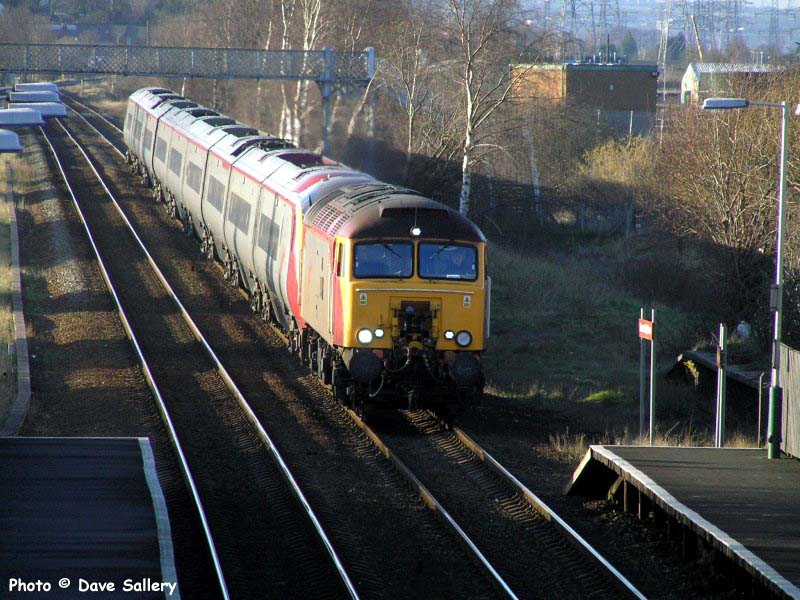
A Virgin class 57 is seen hauling a Pendolino set on a Euston service in February 2009.
The train is now approaching the major engineering structure on the line - Hawarden Bridge. This carries the railway over the tidal River Dee and consists of two fixed bowstring girders and a 287 foot swing span. When the bridge was built the river was quite busy with shipping making its way up as far as Saltney Ferry. This is no longer the case and it is many years since the bridge was opened to river traffic. However shipping has recommenced - see below. The hydraulic tower on the north bank was demolished in 1980 after years of disuse. The bridge carries a public footpath and a cycle way. The cycle way continues to Chester following the trackbed of the closed route to Mickle Trafford.
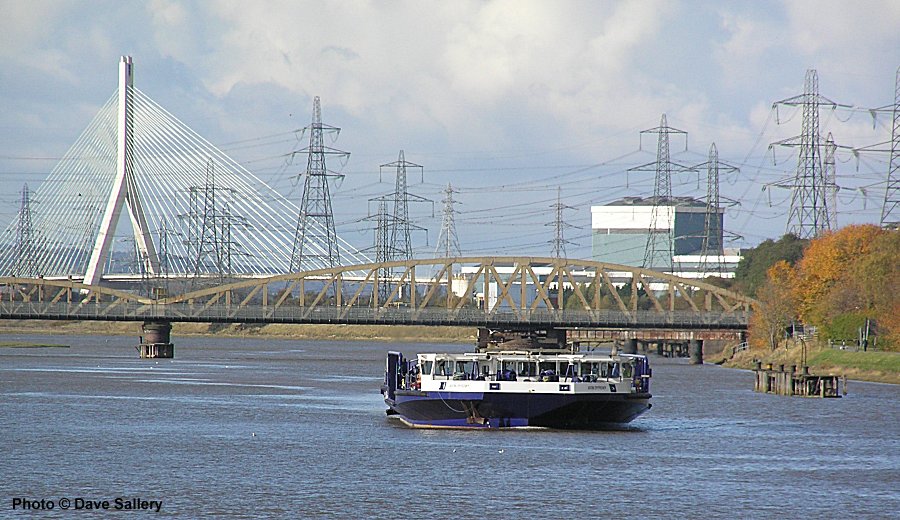
The wings for the new European jumbo jet, the Airbus A380, travel by a specially constructed barge between Broughton and Mostyn. The wings are destined for France and are loaded onto a deep sea ship in Mostyn for Bordeaux. The barge 'Afon Dyfrdwy' is seen here on the River Dee with the railway bridge, road bridge and steel works in the background.
HAWARDEN BRIDGE is reached almost immediately after crossing the river. Very few trains now call here. The halt opened in 1924 when the adjacent John Summers & Sons steelworks was undergoing rapid expansion. Steel making at Shotton steelworks ended in 1980 and the works now concentrates on the coating of steel coils. The works is now part of the Tata group. Leaving the station, Dee Marsh junction signal box is passed on the left and the embankment which formerly carried the line to Chester Northgate and beyond is seen on the right. The large marshalling yard is now passed on the left and behind it are seen various lines heading off towards the coatings complex. The junction at Dee Marsh was formerly triangular and the other arm of the triangle, with track now removed, joins on the right.

The Class 108's were the DMU's that replaced steam in 1958 and they remained in use on the line until withdrawal in 1993. Here Longsight set No. LO615 comes off the bridge and into Hawarden Bridge station on the 13th of November 1992.
The large expanse of reclaimed land now on the left was formerly the John Summers blast furnaces. On the right hand side can be seen the massive Deeside Industrial Estate which is still expanding. Shotton Paper mill with its permanent cloud of steam is on the left just before the train passes under the new road bridge. The site of Shotwick sidings, which formerly fed the north of the steelworks complex, is now occupied by just a solitary track leading to the paper mill. Beyond that are Shotwick firing ranges and the Dee estuary marshlands. The line beyond here to Bidston no longer sees any freight traffic apart from occasional engineering and ballast trains. In previous times this section was busy with trains of iron ore from Bidston Dock to Shotwick sidings.
A short sandstone cutting indicates that the train has now crossed the border into England and shortly the train rattles past the closed station of Burton Point. The next stretch onward to Neston is most attractive with the Dee estuary on the left with the Clwydian range rising up beyond. There are tentative plans to open a new station in the vicinity to be known as Ness. This would serve the Gardens of the same name. Neston is now very much a dormitory town for Chester and Liverpool and the train passes numerous new housing estates. Just before reaching NESTON (at one time Neston North) the line crosses over the remains of the Hooton - West Kirby line. The trackbed of this line has been converted into a footpath and cycle way known as the Wirral Way. Neston station has been modernised and all traces of the original station buildings have now been swept away.
After leaving Neston the train passes through a long wooded cutting as it makes its way across the Wirral peninsula. The next station is HESWALL, at one time known as Heswall Hills. Heswall is the first station in the Merseytravel area.
Another stretch of pleasant countryside follows and the remains of Storeton station are passed. Storeton, Hope Exchange and Burton Point are the only stations on the line to have closed in its long history. The onset of the Birkenhead conurbation is marked as the line passes over the M53 motorway and descends into the Wheeler valley. Merseytravel intend to electrify this part of the line and operate it as part of the Merseyrail system. The plans are to open a new station in the vicinity to be known as Prenton and another station - Beechwood - between here and Upton. If this happens trains from Wrexham will terminate at Prenton rather than at Bidston.
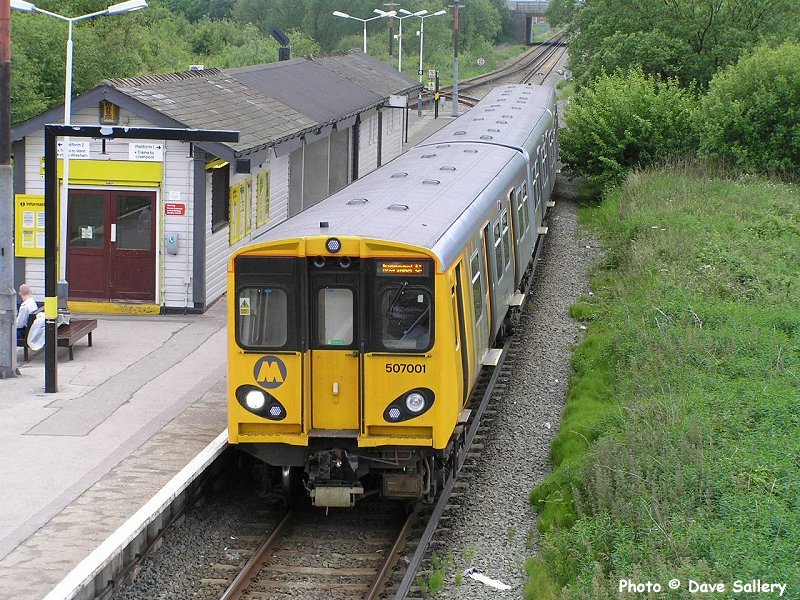
A Merseyrail train at Bidston. The Wrexham line can be seen diverging to the left above the rear of the train.
As the line passes down the valley, with the M53 motorway on one side and housing on the other, we soon arrive at UPTON. It is then only a short trip before BIDSTON is reached around a notoriously sharp curve. All change at Bidston for services to Liverpool in one direction and West Kirby in the other.
Next page: A map of the Borderlands line