
A brief history of the Welsh Slate Industry
This page may also be viewed in the Bosnian language, thanks to Amina Dugalić.

The ruins of disused quarries are still a common sight in parts of North Wales. This is Blaenau Ffestiniog in Merioneth.
In many ways the Slate industry in North Wales was as important to the local economy, culture and history of the area as was the Coal industry of South Wales. Both industries arose out of nothing, became giants on the world stage and then suffered catastrophic decline and almost total extinction. But whereas in South Wales it is sometimes difficult to trace where collieries once existed, due mainly to reclamation, in North Wales there are still many visible examples of the slate industry. Often a little exploration will reward the interested party with a gem of industrial archaeology or an insight into a way of life which nowadays seems harsh and bleak.
The main production areas were around Blaenau Ffestiniog, Bethesda, Llanberis, Nantlle, Corris and Llangollen/Glyn Ceiriog. But, in the boom years, wherever there looked like being a remote chance of finding slate - even if miles from anywhere, then the prospectors would be out scratching at the barren hillsides. Many of these speculative sites never got beyond tiny workings whereas the giants of the industry employed over 3000 men in huge quarries. In between were scores of medium sized workings often with impressive buildings, inclines, machinery and production methods. (continued)
Cedryn Quarry, Cwm Eigiau
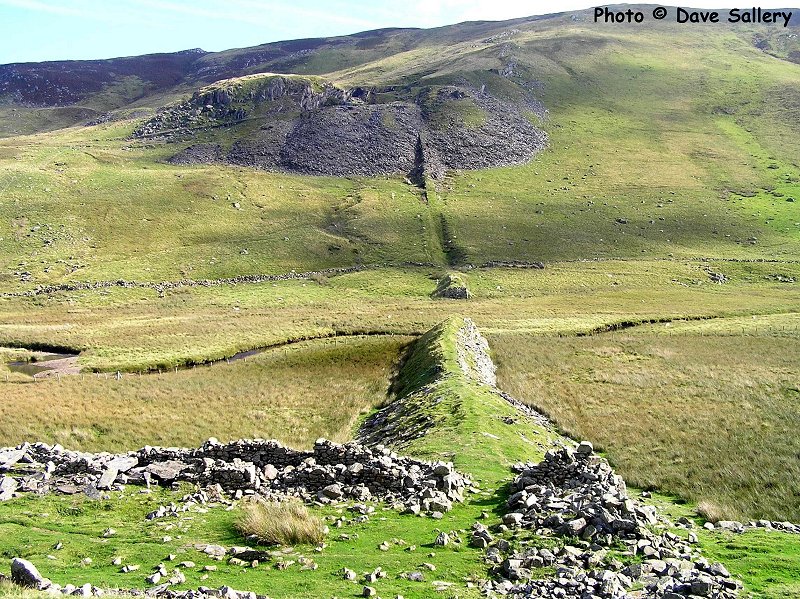
Cedryn is an example of a small quarry of a type once common in North Wales. The quarry, in Cwm Eigiau, was opened in 1827 and had closed by 1868. On the hillside can be seen where the slate was quarried, split and dressed. In the foreground are the remains of the mill where slab was produced. The two were connected by an incline and tramway which crossed the river by a, now vanished, bridge. The quarry was connected to Dolgarrog from the 1820's by a primitive narrow gauge railway which incorporated a further four inclines. This tramway originated at Cwm Eigiau quarry.
Welsh slate was exported all over the world from small ports like Porthmadog or purpose built harbours like Port Dinorwig or Port Penrhyn. To access these ports or to connect the quarries with the nearest town or main line railway, there sprung up a number of narrow gauge railways. The most notable of these being the Ffestiniog which connected Blaenau Ffestiniog and Porthmadog. Other lines were the Talyllyn, Corris, Gorseddau Tramway, Croesor tramway, North Wales Narrow Gauge and the quarry owned Penrhyn and Padarn lines. Because many of these lines originated high in the mountains it was often necessary to incorporate inclined planes in their routes to ease the gradients.
At the
quarries themselves the processes of extracting, splitting
and dressing the slate took place. A very important
part of the extraction process was the removal of rubbish or
waste rock, it was not uncommon for up to 90% of rock to be
disposed of in this way. Most quarries dumped the rock
using end-tipping rubbish wagons over the nearest slope and
the slate waste heaps thus developed, these are the single
most noticeable landscape feature today. Quarry owners
often found that good rock was inaccessible because of
careless rubbish dumping in the past. Not all quarries
produced roofing slates some preferring to concentrate on
slab. Some of its uses were gravestones, steps,
man-hole covers, decorative effects, electricity panels,
hearths, etc. A business also developed in slate
enamelling, the products of which can still be seen in
ornate Victorian mantlepieces. (continued)
Water power

This water wheel, although used at a Welsh copper mine, is typical of those from the early days of slate quarrying. To read more about this water wheel please view my Cwm Ciprwth website
In the early days of quarrying water power was the primary source of energy. Quite often a network of dams were built to supply the water wheels with the water, sometimes this was carried for long distances in wooden or slate lined leats. At the quarry there were sometimes two or more wheels in tandem - the water from the first going on to power the second etc. The coming of steam revolutionised matters but sometimes the water wheels were retained to save the expense of bringing in coal or wood as fuel. Electricity also made an early appearance with Croesor Quarry for example having its own generating station by 1900 and an electrically powered tramway system as early as 1905.
Conditions for the quarrymen were harsh in the extreme and accidents were frequent. Unguarded machinery, roof falls and lung diseases all took their toll. Working underground in the industry was more dangerous than in coal mining. Health and safety legislation was non existent. As many of the workers had come to the quarrying towns to seek work they had to take what was offered. Conditions in the quarry barracks and lodging houses were appalling but in spite of all this a great spirit of comradeship grew up. (continued)
The Barracks

Derelict and roofless quarrymen's barracks at Dinorwic Quarry.
Barracking was common practice in the industry, men would arrive for work early on a Monday morning and remain there until lunchtime on Saturday. Many of the barracks were damp, cold and miserable places to spend the week but often the quarry was too remote to make daily travel a realistic possibility. The barracks and cabans (quarry messrooms) did however develop into great social institutions where politics and religion were debated fervently.

Part of the barracks at Rhosydd Quarry, view my website on Rhosydd here
The industry reached its zenith in the 1890's when half a million tons were produced and nearly 17,000 men were directly employed. It should be borne in mind that well over five million tons of rock would require excavating to reach this figure. From then on decline set in - capital dried up, imports grew, roofing tiles became cheaper than slate and men left for easier ways to make a living. The two world wars deprived the industry of manpower although rebuilding after bombing did provide a brief fillip. One by one the quarries closed and the quarrying districts became deprived areas and the people left. A lot of the remaining quarries continued to use outdated working methods which only added to costs. No part of the industry seemed to be immune from the cycle of decline. When the once mighty Dinorwic closed for ever in 1969 all that was left were a handful of producers.
Currently, Penrhyn Quarry is still thriving and pre-eminent in the industry. In the Blaenau Ffestiniog district Oakeley has recently closed but Cwt Y Bugail and Llechwedd remain open. In the Corris area, a long tradition of underground mining ended some years ago at Aberllefenni although processing of slate continues there. Despite the odds the industry has clung on and thanks to further investment it has grown slightly. There are now several new operators at work on a small scale and the industry, if not exactly buoyant, would seem to have a secure future. It is now however a far cry from the world beating days of old.

Disused levels and incline in Dinorwic quarry, Llanberis.
Next page: Geology and quarrying techniques