Oakeley Quarry, Blaenau Ffestiniog

In terms of size and production no underground working came close to rivaling Oakeley at Blaenau Ffestiniog. It was claimed to be the largest slate mine in the world. Formed from three quarries in the 1880's it produced up to 60,000 tons per annum with a workforce of 1700. There were 26 floors from almost sea level to 1500' and 50 miles of two foot gauge track underground. One of the underground inclines had no fewer than 6 tracks. The site had its own hospital and workers cottages. The whole of the western side of the Conwy Valley railway line and A470 approaching Blaenau from the North is the Oakeley site. Hidden inderneath the waste tips are the remains of a farmhouse, a small holding, Blaenau's first post office, a shop, a bakehouse, a Sunday school building and a number of houses and cottages - evacuated when more tipping space was required. Oakeley closed in 1970 but was reopened shortly afterwards and, for some years, part of it was known as Gloddfa Ganol mountain tourist centre. Gloddfa Ganol offered underground tours of the mine workings and much work went into restoring and exhibiting some of the quarry's fascinating relics.
The site was acquired by Alfred Macalpine Slate in 1998 and vigorous extraction recommenced but this time using modern earth moving machinery. Plans are now afoot to use the waste rock at Oakeley as building aggregate. There are estimated to be 100 million tonnes of waste rock at the quarry and current production is increasing this by 2 million tonnes a year, Should the scheme come to fruition the waste rock will be sent out by rail using the Conwy Valley line. In late 2007 ownership transferred to Irish company Rigcycle now trading as Welsh Slate. The quarry closed in April 2010 and is currently mothballed.

The photographs below show how Oakeley Quarry used to look before its first closure in 1970, older views of Oakeley may be viewed on the "Caban" pages. Today the quarry is worked by Alfred Macalpine and continued extraction has now resulted in the loss of most of the views seen here and the disappearance of nearly all traditional buildings. Extraction of slate today is through surface working and all traces and access to the huge underground workings have been obliterated. Most of the underground chambers are now flooded.
These photographs were
taken by the late Rodney Weaver and are reproduced here by
kind permission of Mr.
G Isherwood.
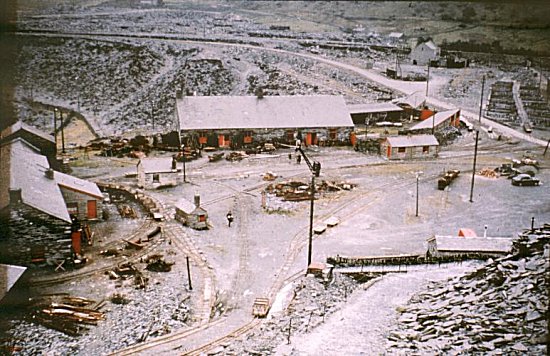
This shows the complex trackwork at the head of the C incline on Bonc Coedan. The incline and workshops are to the left, the Mill to the right while directly in the centre is the smithy. In the far background on the right is the main electric sub-station.
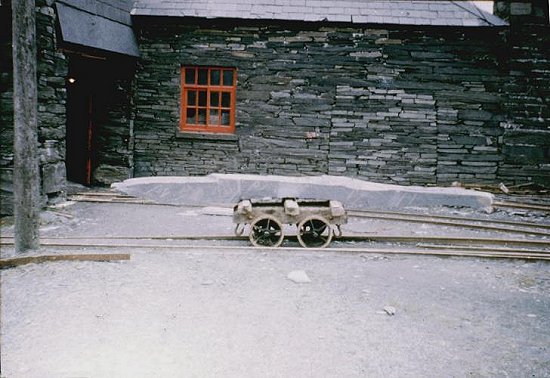
This shows a slab - about 15 feet long - waiting outside the Bonc Coedan Mill to be pushed inside. The chalking shows it originated on floor P. To reach the mill it had to be hauled up the K2 Incline to floor K, then along K to the foot of the K Trwnc, up the K Trwnc to DE floor. Then finally up the C incline to Bonc Coedan.
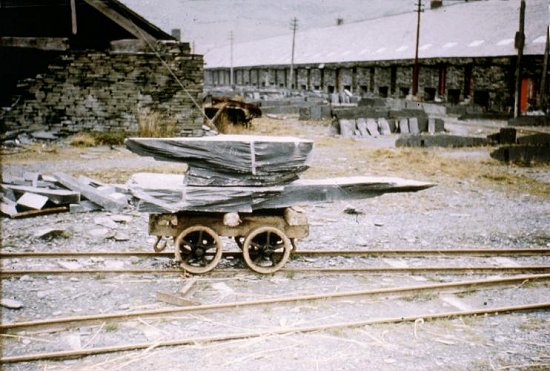
Here are a number of slabs from the mine just outside the Middle Quarry Slab Mill (later the Gloddfa Ganol Mill) in the immediate background is the old Middle Quarry small mill (Felin Fach) while on the right is the derelict Main Mill (Felin Fawr) which dated back to the 1850's.
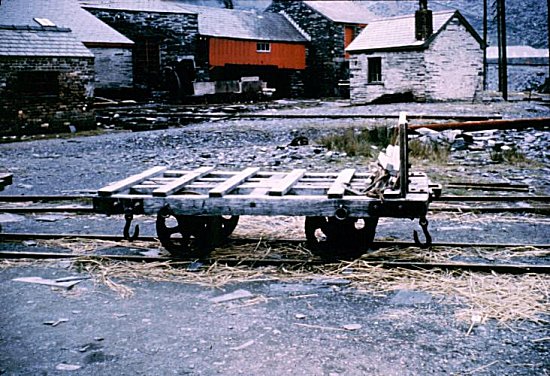
This ancient wooden bodied wagon is on one of the several loop tracks which connected the Bonc Coedan Mill, the C Incline (seen in the background) and the No.5 Incline up to Middle Quarry (Gloddfa Ganol).
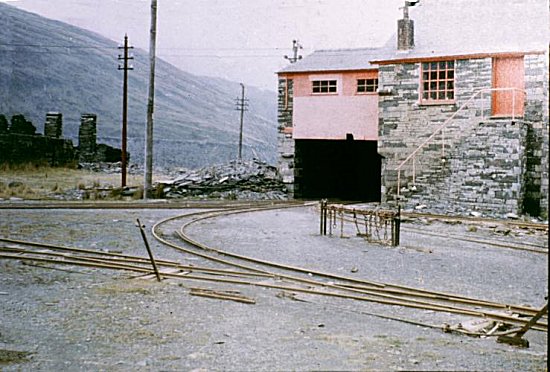
This is the head of the
No.5 incline which raised rock up from Bonc Coedan to the
Middle Quarry Mills floor
(Floor 5).
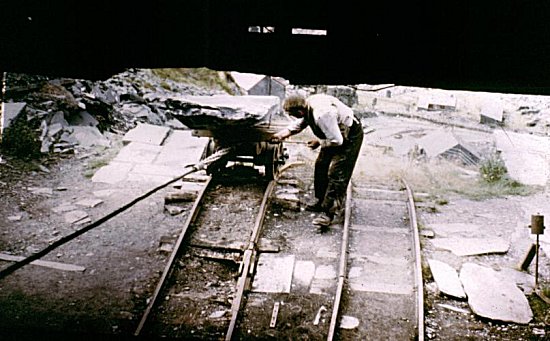
This was taken from the
"stage" of the C incline showing the driver's view down
the incline. One
of the "unhookers" is caught in action about to unhook the
incline cable
from the wagon as it breasts
the crimp (top) of the
incline.
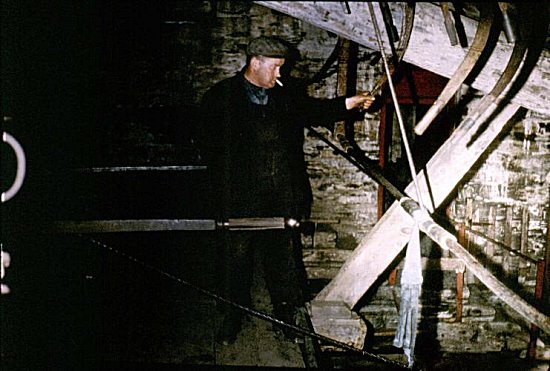
This is the driver on the "stage" of the C incline hauling wagons up from DE floor. He has his hand on the speed control of the winding motor (curved lever) while by his side are the individual clutch and brake levers for the drums. The C incline had four drums, but by the end only one was actually being used.
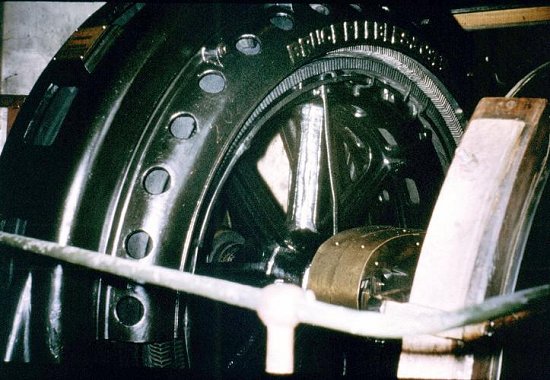
This 200HP 1906 vintage
Bruce Peebles 500V AC electric motor worked the C
incline. Oakeley
was
electrified in that year
using hydro electric generated power from Cwm Dyli at the
foot of Snowdon.
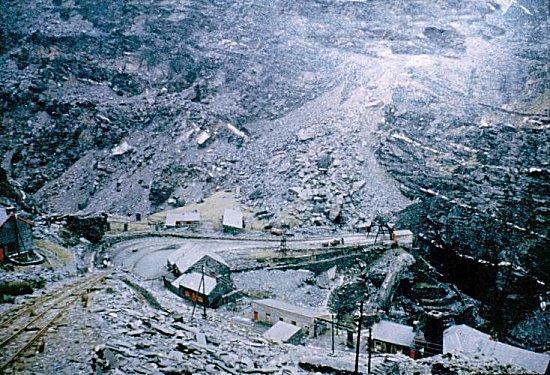
Looking down the C incline to the main entrance to the underground workings.On the left is the C Incline from Bonc Coedan down to DE floor via C. Just visible half-way down on the left is the C compressor building which housed a venerable Ingersoll-Rand piston valve compressor of 1907. At the foor of the incline are the sidings leading to the K Trwnc incline (Centre). The larger building near the foot of the C incline is the K Trwnc motor house. Also visible is the intermediate rope support between it and the headframe with its red control hut. Out of sight to the right, and lower down, is the entrance to the Arches incline. This lead down to H, I and K floors.
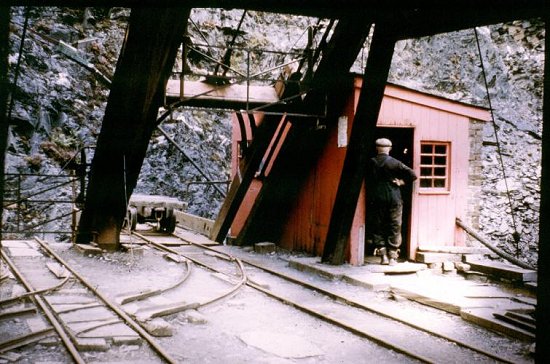
The K Trwnc or Carrier incline connected DE floor in the Sinc with K floor. The incline dated back to about 1874 in terms of its design, although erected in its current location about 1880 or so after the original chamber it was in collapsed. Because of the steepness of this incline the wagons were run onto a movable platform. The headframe seen here was constructed of RSJs and replaced the original heavy timber structure in the 1950's or so. Originally worked by a steam engine the incline was electrified in 1906. The engine, and the electric motor were remote from the headframe to keep them safe from rockfalls and the incline was controlled from the timber hut seen here.

Llechwedd is seen in the foreground with Oakeley beyond. In between, although hidden from view, are the Conwy Valley railway line and A470. The surface workings give little idea of the vast workings below ground. Both sites are still in active production, although all underground production finished many years ago. The buildings in the middle right were formerly Gloddfa Ganol mountain tourist centre.